Data as of . Holdings from the fund’s latest public SEC N-PORT filing; overlap and active share computed by ETFIQ against the IVV and QQQM books; returns from Tiingo end-of-day prices with distributions reinvested.
URA · Global X Uranium ETF
Global X · Themes desk
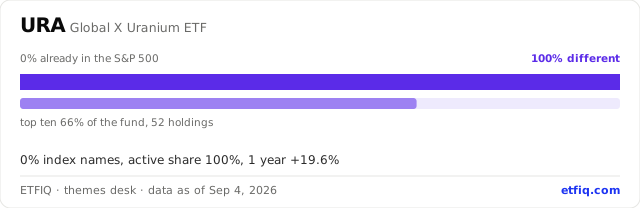
Open the live card on ETFIQBy weight, 0% of URA's portfolio is stocks that are also in the S&P 500; its active share against the S&P 500 is 100%. The top ten holdings are 66% of the fund across 52 positions, as filed for Apr 30, 2026. Over the year to Sep 4, 2026 the fund returned +19.6% with distributions reinvested against +20.0% for the S&P 500, so a holder was about even. It sits 47.6% below its all-time high of Feb 2, 2011.
| Theme (ETFIQ, editorial) | Nuclear and uranium |
|---|---|
| Launched | Nov 5, 2010 |
| Already in the S&P 500, by weight (ETFIQ) | 0.0% |
| Active share vs the S&P 500 (ETFIQ) | 100.0% |
| Already in the Nasdaq-100, by weight (ETFIQ) | 0.0% |
| Active share vs the Nasdaq-100 (ETFIQ) | 100.0% |
| Top ten holdings weight | 66.1% |
| Holdings | 52 |
| Net assets (latest filing) | $7,811M |
| Holdings as of (SEC N-PORT) | Apr 30, 2026 |
| Top holdings | CAMECO CORPORATION 23.1%, Oklo Inc 7.3%, NEXGEN ENERGY LTD. 6.3%, URANIUM ENERGY CORP. 5.8%, Joint stock company National atomic company Kaza 4.8%, Sprott Physical Uranium Trust 4.3%, ENERGY FUELS INCORPORATED 4.2%, DAEWOO ENGINEERING & CONSTRUCTION CO., LTD. 4.1%, PALADIN ENERGY LTD 3.1%, HYUNDAI ENGINEERING & CONSTRUCTION CO.,LTD 3.0% |
| 3 months: total return / S&P 500 / gap / Nasdaq-100 gap (ETFIQ) | +1.7% / +4.7% / −3.0 pts / −0.4 pts |
| 6 months: total return / S&P 500 / gap / Nasdaq-100 gap (ETFIQ) | −5.6% / +15.2% / −20.7 pts / −25.7 pts |
| 1 year: total return / S&P 500 / gap / Nasdaq-100 gap (ETFIQ) | +19.6% / +20.0% / −0.4 pts / −6.0 pts |
| 3 years: total return / S&P 500 / gap / Nasdaq-100 gap (ETFIQ) | +112.1% / +78.0% / +34.1 pts / +18.6 pts |
| since launch: total return / S&P 500 / gap / Nasdaq-100 gap (ETFIQ) | −30.8% / +729.7% / −760.5 pts / −1465.7 pts |
| Below its all-time high (ETFIQ) | −47.6% |
| Expense ratio (prospectus XBRL) | 0.69% |
| Fee for the part that differs from the S&P 500, active expense ratio (ETFIQ) | 0.69% |
| Closest funds by holdings overlap | NLR 51%, URAN 34%, TNUK 27%, RCTR 25%, NUKZ 23% |
Questions people ask
- How much of URA is already in the S&P 500?
- By its holdings filed for Apr 30, 2026, 0% of URA by weight is stocks the S&P 500 already holds. Its active share against the index is 100%, so that share is the part doing something different.
- What does URA hold?
- 52 positions as filed for Apr 30, 2026, with the top ten at 66% of the fund. The largest are CAMECO CORPORATION at 23.1%, Oklo Inc at 7.3%, NEXGEN ENERGY LTD. at 6.3%.
- Has URA beaten the S&P 500?
- Over the year to Sep 4, 2026 URA returned +19.6% with distributions reinvested, against +20.0% for the S&P 500, so it finished about even with the index by 0.4 points.
- What does URA cost?
- The prospectus expense ratio is 0.69% a year. Because 100% of the fund differs from the S&P 500, the fee on that differing part works out at 0.69%.
Where these figures came from
ETFIQ links to the documents behind every figure. It is not affiliated with any issuer, and a link is not an endorsement.
Compare URA
Funds near this one
Put this on your own page
The difference bar for URA, redrawn every trading night. Free to use with the credit link; paste these two lines into any page or newsletter.
<a href="https://etfiq.com/funds/URA.html"><img src="https://etfiq.com/embed/themes/URA.svg" alt="URA difference bar, ETFIQ" width="640"></a>
<p><a href="https://etfiq.com/funds/URA.html">URA difference bar, updated daily by ETFIQ</a></p>
Cite this page. ETFIQ, URA on the themes desk, data as of Sep 4, 2026. https://etfiq.com/funds/URA.html Free to use with attribution; the underlying files are at Open data.
ETFIQ is an independent publisher of exchange-traded fund data. It is not a fund issuer, broker-dealer or investment adviser, and it makes no recommendations; sort orders and figures are stated arithmetic on published data. Standards · How to read this desk