UCTX Corgi UCTT 2x Daily ETF
Aims to return twice the daily move of UCTT
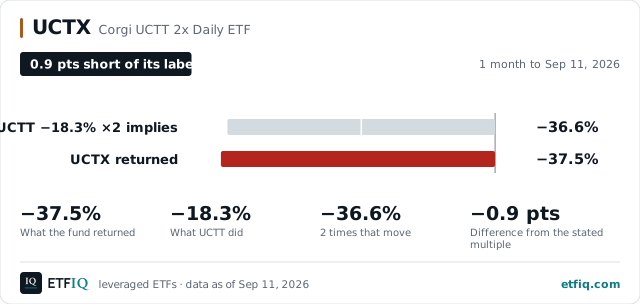
One month to Sep 11, 2026: UCTX returned −37.5% where its own daily promise gave −36.6%, 0.9 points short.
Key facts
What it aimed at, and what it did
Over the window to Sep 11, 2026, UCTT moved −18.3%. UCTX returned −37.5%, where 2 times that move implies −36.6%. The difference is −0.9 pts.
Period by period
| Window | Fund | UCTT | +2x the move | Difference | UCTT moved about |
|---|---|---|---|---|---|
| 1 month | −37.5% | −18.3% | −36.6% | −0.9 pts | 75% |
| Since launch | −80.3% | −48.1% | −96.1% | +15.9 pts | 111% |
In plain words
Read the multiple against the whole window instead and +2 times UCTT's −18.3% implies −36.6%, which makes UCTX look 0.9 points short. 0.0 of that is daily compounding, which happens to any +2 times fund over the same path, and the rest is the fund. UCTX aims to return +2 times UCTT's move each day, then resets. Over one day it does that. Over longer, the daily results compound, so the total is not +2 times the period's move: in a market that falls and comes back it is reliably less, and in a steady run it can be more. UCTT moved at 75% annualized over that window. That is what decides how far the two figures separate: the same fund on a calm underlying and a violent one is a different product.
| Sets out to return | +2 times the daily move of UCTT, reset daily |
|---|---|
| Multiple a holder actually got over the window (ETFIQ) | +2.05 times, against +2 stated |
| Underlying | UCTT |
| Segment | single stock, company |
| Expense ratio (485BPOS XBRL, Jun 5, 2026) | 0.45% |
| Launched | Jun 30, 2026 |
| Underlying volatility over the window (ETFIQ) | 75% annualized |
Returns are ETFIQ calculations from Tiingo end-of-day prices, distributions reinvested, measured against the underlying over exactly the same days. How these figures are computed
Questions people ask
- Did UCTX return +2 times UCTT?
- Over the window to Sep 11, 2026, UCTT moved −18.3% and UCTX returned −37.5%. 2 times that move is −36.6%, so the fund came out 0.9 points short of it.
- Why does UCTX not return +2 times over a year?
- Because it resets daily. UCTX aims at +2 times each day's move, and daily results compound. Over a run where the underlying falls and comes back, compounding a levered daily return leaves a holder behind what +2 times the period move would suggest; over a steady run in one direction it can leave them ahead. The longer the holding, and the more the underlying moves about, the further apart the two figures get.
The words on this page
- Stated multiple
- What the fund sets out to return against its underlying, each day. A fund at 2x aims to return twice the underlying’s daily move, and an inverse fund at -2x aims to return twice it in the opposite direction.
- Daily reset
- The fund starts each day aiming at the multiple again, from wherever it now stands. It is the mechanism that makes these funds behave as they do, and the reason the stated multiple applies to a day rather than to a holding period.
- Compounding
- Daily results multiply together rather than adding up. Two days of the multiple is not twice the multiple, and over a run of days the difference between the two grows with how far the underlying moves about.
- Decay
- What compounding costs a holder when the underlying falls and rises back to where it started. The underlying is level and the fund is down; the more violently it moved, the further down.
- Difference against the stated multiple
- The fund’s return minus the stated multiple times the underlying’s return, in percentage points. The one figure that says whether a holder got what the fund’s own multiple describes.
Every term used here, defined in full on the leveraged ETFs vocabulary page.
Where these figures came from
ETFIQ links to the documents behind every figure. It is not affiliated with any issuer, and a link is not an endorsement.
Where to next
Put this on your own page
The label bar for UCTX, redrawn every trading night. Free to use with the credit link.
Where UCTX is written about
Use this data, or open the live card
Open UCTX live on ETFIQ, where the figures refresh with the data.
Cite this page. ETFIQ, UCTX, leveraged ETFs, data as of Sep 11, 2026. https://etfiq.com/funds/UCTX Free to use with attribution; the underlying files are at Open data.