RMIF · LHA Risk-Managed Income ETF
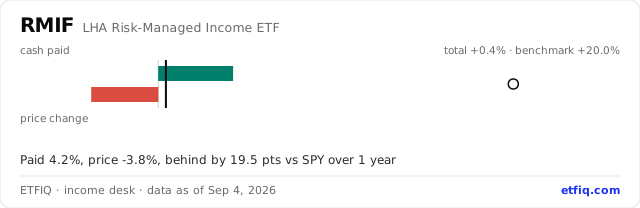
Over the past year RMIF paid 4.2% in cash and still finished 19.5 points behind SPY.
What a holder got
Over the year to Sep 4, 2026, RMIF returned +0.4% with distributions reinvested and S&P 500 (SPY), used as a default proxy returned +20.0%, so a holder came out behind it by 19.5 points. The lighter segment is the 4.2% that arrived as cash rather than as price.
Period by period
| Window | Cash paid | Price | Total return | SPY | Ahead or behind |
|---|---|---|---|---|---|
| 3 months | 0.4% | −0.2% | +0.2% | +4.7% | −4.5 pts |
| 6 months | 1.4% | −1.4% | +0.1% | +15.2% | −15.1 pts |
| 1 year | 4.2% | −3.8% | +0.4% | +20.0% | −19.5 pts |
| 3 years | 16.6% | −4.4% | +12.9% | +78.0% | −65.0 pts |
| Since launch | 17.9% | −3.6% | +15.2% | +86.7% | −71.4 pts |
In plain words
With every distribution reinvested, the fund returned +0.4%. S&P 500 (SPY), used as a default proxy returned +20.0% over the same days, so a holder was behind by 19.5 pts. At its price on Sep 4, 2026 the latest distribution annualises to 4.5%, paid monthly.
| Strategy | option income |
|---|---|
| Benchmark | S&P 500 (SPY), used as a default proxy (proxy) |
| Pays | monthly |
| Net assets (SEC filing, whole fund, as filed for Jun 30, 2026) | $25m |
| Latest payout, annualised (ETFIQ) | 4.5% |
| Expense ratio (prospectus XBRL) | 1.55% |
| Cash paid, trailing 12 months (ETFIQ) | 4.4% |
| Launched | Jun 9, 2023 |
Every figure is an ETFIQ calculation from exchange prices and cash distributions (Tiingo end-of-day), total return with distributions reinvested. Return of capital is the issuer’s estimate. How this desk computes every figure
Questions people ask
- How much has RMIF paid over the last year?
- Over the year to Sep 4, 2026, RMIF paid 4.2% of its starting price in cash distributions, while the price fell 3.8%.
- Is RMIF ahead of SPY?
- Over the year to Sep 4, 2026, with every distribution reinvested, RMIF returned +0.4% against +20.0% for S&P 500 (SPY), used as a default proxy, so a holder was behind it by 19.5 points.
- How often does RMIF pay, and how much?
- RMIF pays monthly. The latest distribution annualises to 4.5% at its price on Sep 4, 2026, which is not a promise; the next one can differ.
- What does RMIF cost?
- The prospectus expense ratio is 1.55% a year.
The words on this page
- Total return
- What a holder actually ended up with: price change plus every distribution, reinvested. The only figure that answers whether you came out ahead.
- Cash paid
- Distributions over the window as a share of what the fund cost at the start. A measure of cash delivered, not of return: a fund can pay a great deal and still lose money.
- Ahead or behind
- The fund’s total return minus the benchmark’s over exactly the same days, in percentage points. Both sides reinvest.
- Return of capital
- The issuer’s own estimate, in a Rule 19a-1 notice, of how much of a distribution was your own money returned. An estimate and a tax characterisation, not a measure of erosion.
- Covered call
- Selling call options on shares the fund holds. It collects a premium and gives up the gains above the strike, which is why these funds pay well and lag a rising market.
Every term this desk uses, defined in full on the income desk vocabulary page.
Where these figures came from
ETFIQ links to the documents behind every figure. It is not affiliated with any issuer, and a link is not an endorsement.
Funds near this one
Put this on your own page
The payout bar for RMIF, redrawn every trading night. Free to use with the credit link; paste these two lines into any page or newsletter.
<a href="https://etfiq.com/funds/RMIF.html"><img src="https://etfiq.com/embed/income/RMIF.svg" alt="RMIF payout bar, ETFIQ" width="640"></a>
<p><a href="https://etfiq.com/funds/RMIF.html">RMIF payout bar, updated daily by ETFIQ</a></p>Use this data, or open the live card
Open RMIF on the live ETFIQ desk, where the figures update as the desk refreshes.
Cite this page. ETFIQ, RMIF on the income desk, data as of Sep 4, 2026. https://etfiq.com/funds/RMIF.html Free to use with attribution; the underlying files are at Open data.